New & replacement stations
Pumping station installation in Buckinghamshire
Whether it is a barn conversion with no gravity route to the sewer, a self-build down a long drive or a handful of new homes, we design, supply, install and commission packaged pumping stations that suit the site.
When do you need a pumping station?
If the drains from a building sit lower than the sewer they need to reach, gravity alone will not do it. The same applies if the only route to the sewer runs uphill, or if surface water has to be lifted away from a basement, a sunken driveway or a low-lying yard.
In Buckinghamshire that comes up all the time. The Chilterns' steep valleys put plenty of properties below the road and the public sewer, and many rural homes, farm buildings and barn conversions are being connected for the first time as they are redeveloped.
How an installation runs
- Survey and levels. We look at the drainage layout, the invert levels, the distance and height to the discharge point and how many people or what type of building the station will serve.
- Design and quote. From that we size the chamber, choose single or twin pumps, pick the control and alarm arrangement and give you a clear written quotation.
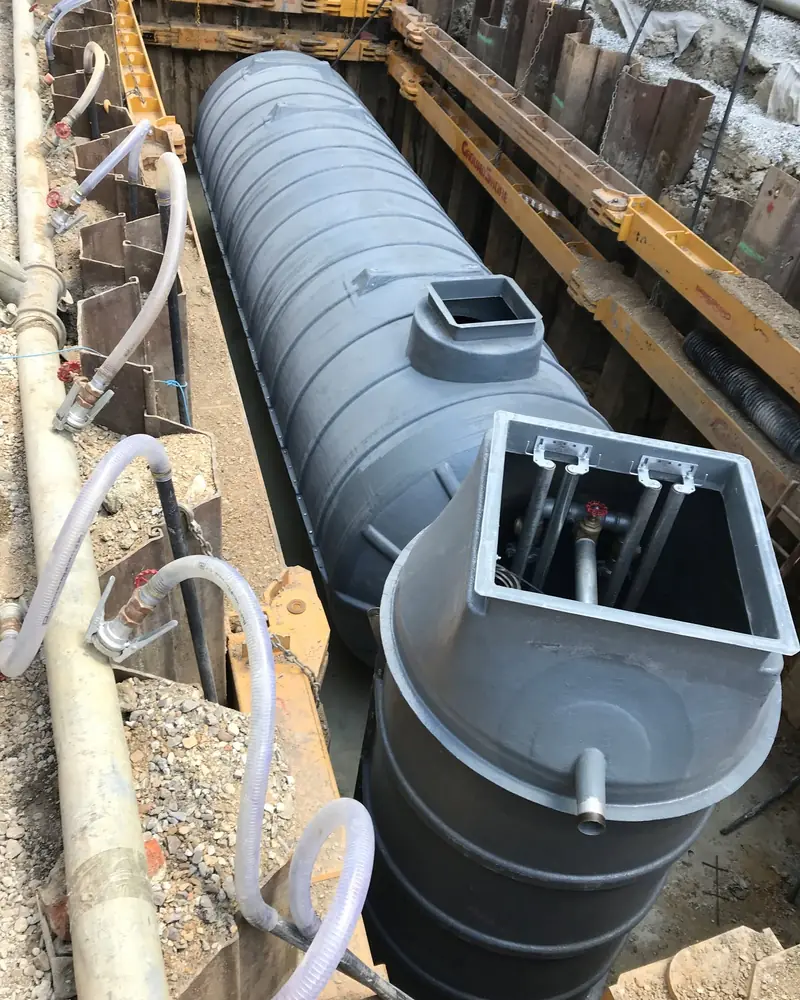
- Excavation and installation. The chamber is set in the ground, anchored and backfilled correctly, then the inlet, rising main, ducting and electrics are connected.
- Commissioning. We test the pumps, level controls and alarm under working conditions, adjust the settings and show you how the panel works.
- Handover. You receive the commissioning record and the information you need for building control, plus the option of a planned service agreement from day one.
Getting the details right
A station that is too small fills too quickly and runs constantly. One that is oversized lets waste sit and turn septic. We size the chamber for the real daily flow, with enough emergency storage above the alarm level to buy time if the power goes off or a pump fails.
We also think about the people who will live with it: where the cover sits in the garden, a load rating to match any vehicles that might drive over it, where the panel is mounted so the alarm will actually be heard, and access for a tanker in future.
Packaged, private and adoptable stations
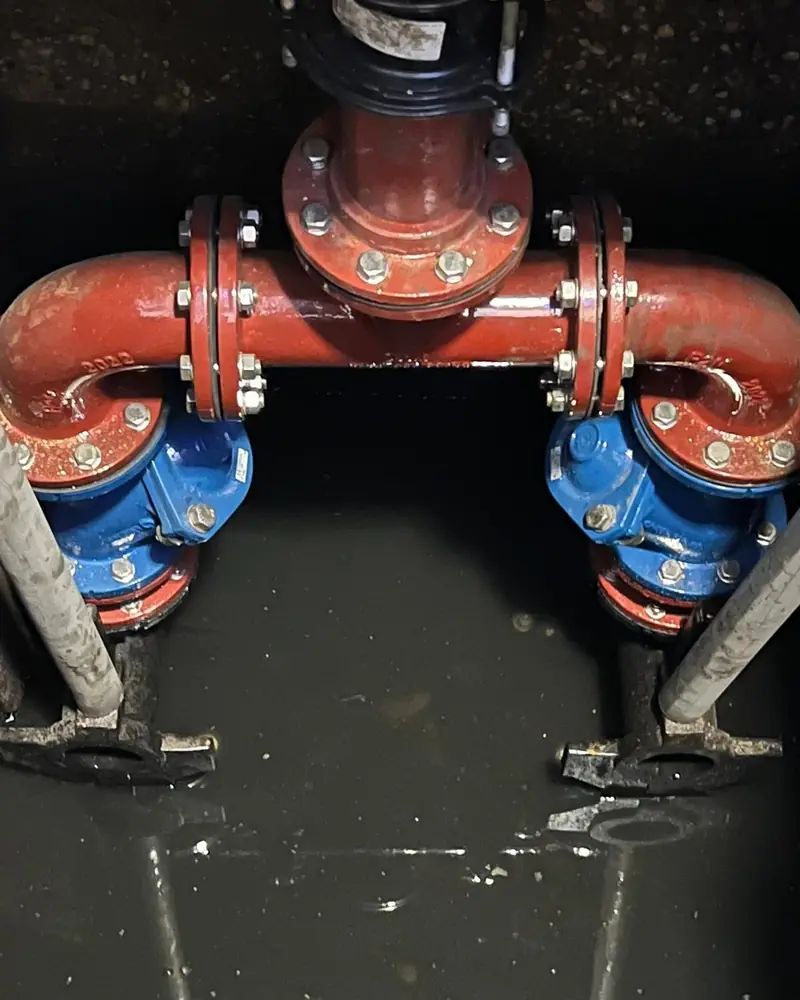
Most new stations we fit in Buckinghamshire are packaged units: a GRP chamber supplied with the pumps, pipework and controls already designed as a set. They suit single houses, annexes, barn conversions and small commercial plots, for foul sewage, surface water, or both.
A private station stays with the owner, or with the residents jointly on a shared site. That is the usual arrangement for a house, a block of flats or a small development that will not be offered to the water company.
On larger housing schemes the station may need to be adoptable, so that the sewerage undertaker can take it over once the homes are finished. In most of Buckinghamshire that is Thames Water; around Milton Keynes and the north of the county it is often Anglian Water. Those stations are specified more tightly: chamber size, emergency storage, valve arrangement, kiosk, tanker access and the records handed over at commissioning all have to match the undertaker's current requirements. If adoption is the aim, say so when you first get in touch and we will design accordingly.
Whatever the arrangement, the station has to be a safe, maintainable piece of kit. We design private installations to BS EN 12050, the British Standard for wastewater lifting plants, and we take account of BS EN 752 for the drains that feed them. Where a station is intended for adoption we follow the undertaker's present specification, the Design and Construction Guidance issued under the Code for Adoption, which many people still know by the older name Sewers for Adoption.
Upgrading an existing station
Not every project starts with an empty plot. Extensions, extra bedrooms and new annexes add flow to a station that was sized for less. We can check whether your existing set-up has the capacity, then upgrade the pumps, controls or storage, or replace the station outright if that is the more sensible spend. If your current station is simply worn out, see our page on repairs and refurbishment too. Planned servicing after commissioning is something we can set up from day one.
Before you start on site
Installation questions
How long does a new installation take?
A straightforward packaged station for a house or conversion is often installed in a few days once the chamber is on site, though wet ground, access and the electrics can stretch that. Larger or adoptable stations take longer because of the design approvals and the civil work. We will give you a programme with the quotation.
Can you fit a packaged station in a tight garden?
Often yes. We look at access for the excavation, where the cover and the panel will sit, and how a tanker would reach the chamber in future. If a standard chamber will not fit, we can usually specify a different layout rather than force a poorly placed well into the only open patch of lawn.
What standards do you design a new station to?
Private installations are designed to BS EN 12050, the British Standard for wastewater lifting plants, and we take account of BS EN 752 for the surrounding drainage. Stations that are meant to be adopted are designed to the sewerage undertaker's current Design and Construction Guidance, issued under the Code for Adoption.
Will you look after the station once it is commissioned?
Yes. We can put the new station on a service plan from the first year, so the same team that installed it is the one that comes back to inspect it. That is often the simplest way to keep the warranty in good order and to catch small faults early.
Planning a new pumping station?
Send us the drainage drawing or a rough sketch of the site and the levels if you have them. We will come back with questions, a site visit if needed and a written quote.